Press "Enter" to skip to content

Macedonian Prosecutor Implicates Former Political Leaders in Money Laundering, Extortion, Illicit Land Deals

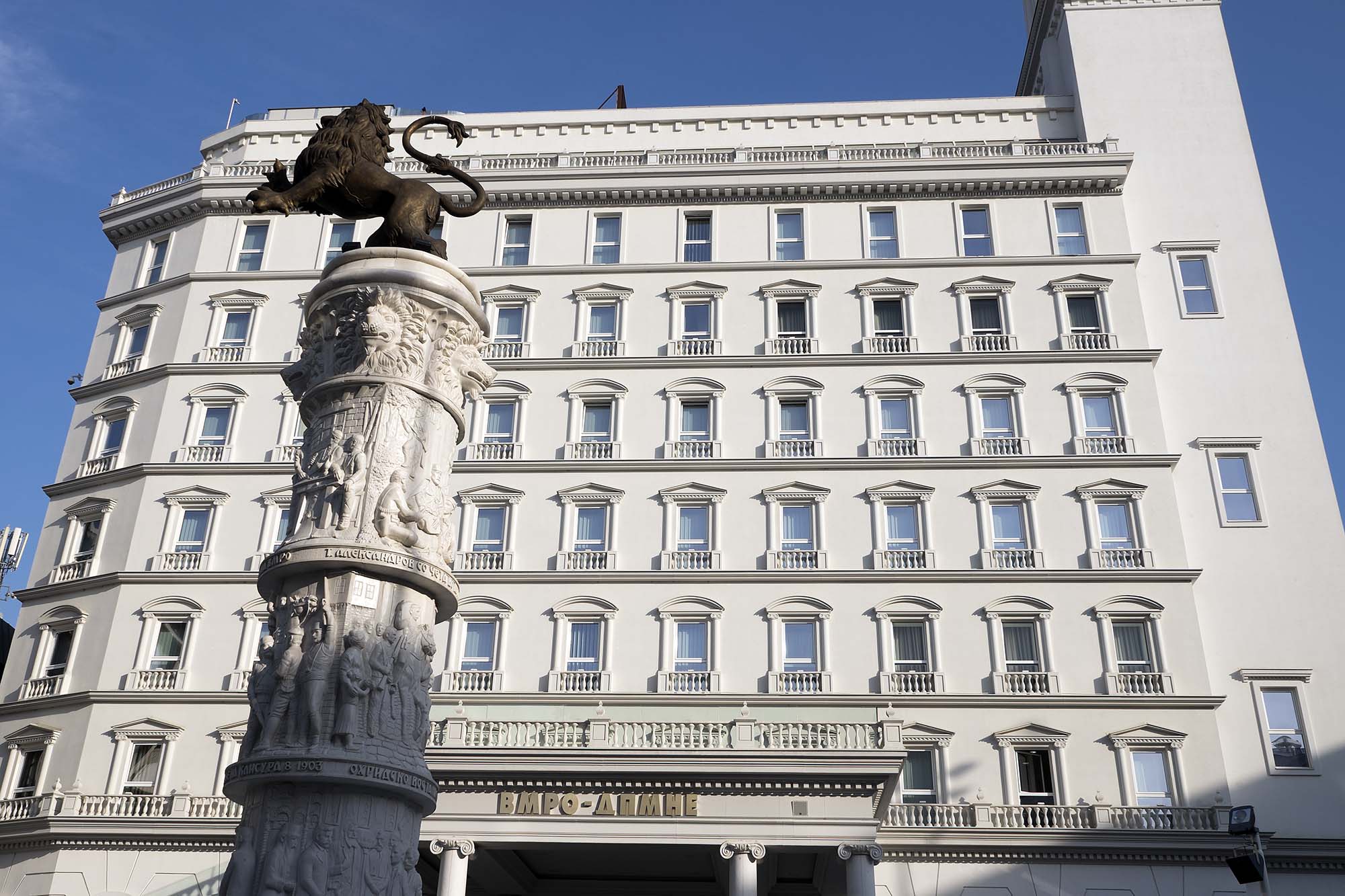
A wide-ranging corruption investigation by the Macedonian special prosecutor has unearthed new evidence of wrongdoing in dozens of deals by VMRO-DPMNE, the right-wing party that ruled the country between 2006 and 2017.

The prosecutor alleged that the party illegally collected at least 4.6 million euros in a money laundering and extortion scheme, accepted illegal donations to construct its lavish “White Palace” headquarters in Skopje, and illegally purchased at least 68 other properties across the country worth 17.5 million euros in total.

The allegations are part of two indictments charging party officials — including former Prime Minister Nikola Gruevski, who fled to Hungary in November — with money laundering and abuse of their official positions. Gruevski has been convicted and other party officials charged in related cases as part of a broader government corruption probe.

An analysis by reporters from the Investigative Reporting Lab Macedonia, OCCRP’s Macedonian member center, used public records and documents from prosecutors to pinpoint the 69 party-owned properties at issue, some of which have no obvious links to VMRO-DPMNE functions. This report marks the first time the detailed property list has been published. At the time of the purchases, which included fields, pastures, apartment buildings, and private houses, such party ownership was forbidden under Macedonian law. Prosecutors have not disclosed who, if anyone, used the real estate.

The Skopje Criminal Court, acting on a request from the office of the special prosecutor, froze the 69 properties on Oct. 31, 2018, including the White Palace headquarters.

The action came after party leader Hristijan Mickoski told reporters that VMRO-DPMNE was short of funds and might have to sell or rent its headquarters. The freeze means that the party cannot sell or mortgage the White Palace or other properties.

The questionable land deals and allegations that party officials ran an extortion and money laundering scheme came to light as part of a broad investigation that Special Prosecutor Katica Janeva and her colleagues have been pursuing for more than a year and a half. This part of the widening probe into corruption is known as Talir, named after a centuries-old silver coin.

Janeva was appointed special prosecutor by Macedonian lawmakers in 2015 after pressure from the European Union. After president Gjorge Ivanov halted probes into more than 50 public figures embroiled in a wiretapping scandal (including Nikola Gruevski), protesters took to streets in Skopje and other cities in the summer of 2016 in support of the special prosecutor, who had been working on the case.

Information from the wiretapped conversations has helped prosecutors bring indictments for a wide range of questionable deals in areas including real estate and government contracting.

In a prelude to the most recent indictments, deputy special prosecutor Lence Ristoska said at a news conference in 2017 that evidence pointed to “real estate purchased on behalf of the political party, but not used for party purposes,” a violation of Macedonian law. She added: “We noted that there are no party features at all on those properties. In some cases we have properties that are not marked [with a party insignia] and we have situations where there are pastures or fields, which are obviously not used for the purposes of the political party.”

The indictments allege a complex web of donations and deals that violate Macedonian law. Prosecutors believe Gruevski and Kiril Bozinovski, the party secretary-general, gained a disproportionate benefit for VMRO-DPMNE in the deal to construct the White Palace party headquarters, they said in a news release. The party paid only 815,323 euros for a building that is now valued at 14 million euros, meaning it could reap a huge profit if sold.

In July, the new Social Democratic Union of Macedonia (SDSM) government and Parliament eased restrictions on property ownership by political parties, allowing them to own land and other real estate and rent out their properties. But the new law does not affect the pending criminal cases because it isn’t retroactive.

VMRO-DPMNE didn’t respond to questions emailed by the Investigative Reporting Lab Macedonia about the new charges and the party properties under investigation.

To show the scope of the VMRO-DPMNE’s real estate holdings, Investigative Reporting Lab Macedonia has created an interactive map based on information supplied by the special prosecutor’s office.

The map shows the party’s 69 frozen properties across the country.

The most valuable is the White Palace, VMRO-DPMNE’s Skopje headquarters, where public real estate records show 3,816 square meters of business space on 1,240 square meters of land.

The other properties include houses, stores, apartments, lots with buildable land, lots with buildings under construction, gardens, and fields. All the properties on the map were purchased between 2009 and 2015, the period covered by the investigation, and were listed in documents from the special prosecutor’s office.

Unless the properties are linked directly to party functions, such ownership would have been illegal at the time the real estate was acquired.

Property Freeze, Then New Indictments

The freeze on party properties came just a few weeks before the prosecutor’s office filed the two new indictments against Gruevski, the former VMRO-DPMNE prime minister of Macedonia who fled to Hungary last year, and other party officials.

The indictments, issued on Nov. 22, 2018, have already led to one guilty plea from a party official; two others are awaiting trial.

The officials, including Gruevski, “pressured representatives of the legal entities that had concluded public procurement contracts with state bodies, public enterprises or units of local self-government to provide cash for the political party VMRO-DPMNE,” the prosecutor’s office said in the indictment. Party officials then used illegally obtained funds to buy the questionable real estate.

In the indictments, prosecutors alleged that Gruevski, who was prime minister from 2006 to 2016, used illegally obtained funds to finance VMRO-DPMNE and its activities, including acquiring various properties across Macedonia and building the party headquarters in Skopje.

The first indictment accused Gruevski, former party secretary Bozinovski, former Minister of Transport and Communications Mile Janakieski, and parliamentarians Ilija Dimovski, Leko Ristoski, and Elizabeta Cingarovska, as well as the VMRO-DPMNE party, of illegally receiving 4.6 million euros. The prosecutors said the illegally acquired funds were entered in party records as fictitious payments and then funneled into real estate deals between 2013 and 2015.

Cingarovska recently entered a guilty plea and was sentenced to two years’ probation.

Prosecutors said they believe Gruevski knew the party was violating the rules as far back as 2009, but authorized the funding scheme to strengthen both the party and his control over it.

White Palace Construction Deal Questioned

The second indictment charged Gruevski and Bozinovski with irregularities in the construction of the White Palace, which was completed in 2015. That includes a payment of 8.2 million euros from Beton, a major construction company that built the party headquarters. The company placed 2.1 million euros in cash into the party’s account and invested another 6.9 million euros in the construction, while VMRO-DPMNE paid Beton only 815,323 euros — which meant that Beton’s overall investment totalled 8.2 million euros.

Beton’s connections and contributions to the party were illegal. Macedonian law bars companies from contracting with or making donations to political parties if they participated in a major public works project, as Beton had.

The company, owned by Mincho Jordanov, one of Macedonia’s wealthiest businessmen, had government contracts to build elements of the Skopje 2014 project, a massive makeover of Skopje that was derided by critics as a waste of public funds. The company was paid more than 200 million euros for its work on that project.

Prosecutors said that over 75 percent of Beton’s revenue in 2011 and 2012 came from state and local governments and from public enterprises run by VMRO-DPMNE officials, further amplifying their allegations that the links between the company and the party were illegal.

Gruevski Gone; Party Says Prosecutions Are Politically Motivated

Gruevski said on his Facebook page on Nov. 20 that he had been granted asylum in Hungary. The Hungarian interior ministry reported that he had met the conditions for asylum.

Macedonian officials are calling for his return. Gruevski was supposed to begin a two-year prison sentence following his conviction in May for putting pressure on then-Interior Minister Gordana Jankuloska to get her office to buy a 580,000-euro Mercedes for his personal use.

Gruevski also faces charges in four other corruption cases, and is under investigation in two more, the prosecutors have said.

After the Oct. 31 freeze was imposed by the court, VMRO-DPMNE officials questioned the motives of the special prosecutor, complaining that the effort was an attempt to damage an opposition political party.

Dimche Arsovski, the party’s spokesman, described the prosecution as politically motivated and unprecedented in Europe.

So far, prosecutors have questioned more than 500 witnesses and collected 11,000–12,000 records of donations to the party treasury. Prosecutors have also examined thousands of documents from municipalities, the official real estate list maintained by the government, and private firms and banks.

David Ilieski contributed to this story.

Sashka Cvetkovska

Sashka Cvetkovska

Еditor-in-chief

Sashka Cvetkovska is an internationally awarded investigative journalist and editor-in-chief of the Investigative Reporting Lab. Cvetkovska has worked on a number of national and cross-border investigations that have uncovered domestic and international crime, corruption, illicit arms trafficking and disinformation wars. The research she has worked on has been published in The Guardian, Buzzfeed, Süddeutsche Zeitung and others. Her current responsibilities are focused on increasing the impact of investigative reporting by creating new narratives of stories through film and campaigns. In that direction, she currently holds the position of producer of the Investigative documentary series Newsroom. For ten years, Cvetkovska has been part of the research team of the International Organized Crime and Corruption Reporting Project, an international media organization associated with IRL. She was a member of the Board of Directors of OCCRP and the Association of Journalists of Macedonia.

Elena Mitrevska Cuckovska

Elena Mitrevska Cuckovska

Editor for Development and Operations

Elena Mitrevska Cuckovska is the co-founder of IRL and together with the editor and his assistant, is responsible for monitoring and designing the implementation process of IRL activities. She is the project director of the documentary series Newsroom. She has been working with journalists for more than 10 years and has also worked on other technological solutions that allow more efficiency when searching public databases used by our reporters in order to make their work faster. She is a software engineer and graphic designer by profession and she is also the first technology expert who is trained and works in the field of media. She is part of the cross-border group of technological experts of OCCRP and contributes in collecting and analyzing information and as a researcher in IRL.

Bojan Stojanovski

Bojan Stojanovski

Editor and journalist

Bojan Stojanovski is a graduated journalist with over ten years of media experience. He worked in several national televisions – TV Alfa, TV 24 Vesti and TV Alsat. From first of November 2021, he is a part of the IRL team. Throughout his career, Stojanovski followed topics in the field of judiciary, crime, corruption. In 2013, he received “Nikola Mladenov” award for investigative journalism, on the topic “Employment in the public administration through the party list”.


Denica Chadikovska

Denica Chadikovska

Assistant managing editor for organization and communications

Denica Chadikovska is a graduated psychologist who started her journalistic career in 2017 as co-author and co-producer of the youth show Krik, funded by the UK Government. Chadikovska becomes part of the IRL team in 2018 as an investigative journalist – intern within the project for training future media leaders. In June 2020, she joins the position of communications officer in charge of implementing the IRL’s communications strategy as part of the communications and products team.

Maja Jovanovska

Maja Jovanovska

Researcher and journalist

Maja Jovanovska has a degree in journalism and follows topics in the field of corruption, crime and justice. In her long-term career, she worked in numerous media such as A1 television, Channel 5 television, Alsat and the NOVAtv portal before joining the founding board of IRL in 2018. She is the winner of domestic recognitions and awards and has participated in a number of trainings and conferences in the field of investigative journalism. She was a member of the management of the Independent Union of Journalists and Media Workers of Macedonia and the Council of Ethics in the Media in Macedonia, and is currently part of the management of ZNM.


Aleksandra Denkovska Gocevska

Aleksandra Denkovska Gocevska

Researcher and journalist

Aleksandra Denkovska Gocevska is a graduated journalist with ten years of experience. She worked in the daily newspaper Nova Makedonija, the Meta.mk news agency and the NOVATV portal. During her career, she worked on topics from the field of politics, urbanism, judiciary and corruption. She started working with investigative journalism in 2015 when she came to work as a reporter in the investigative newsroom of NOVATV. She is a participant in dozens of conferences and workshops on investigative journalism and is the author of the first undercover investigative story in Macedonia about the lives of the children from the May 25 home.

Aleksandar Janev

Aleksandar Janev

Researcher and journalist

Aleksandar Janev is a graduated economist who began his career as an economic journalist in 2008 at Alfa Television. He developed his professional reporting skills through training sessions with top economic journalists both domestically and abroad, including at Reuters in the United Kingdom. In 2010, he transitioned to the print media at Capital, where he worked until 2022. Concurrently, he contributed regularly to the Balkan Investigative Reporting Network (BIRN), and since 2018, he has been both an author and editor for the TV program “Agenda 35” broadcasted on Macedonian Radio Television. Since 2023, he has been a part of the IRL team focusing on corruption and economic crime.

Ivan Blazhevski

Ivan Blazhevski

Researcher and journalist

Ivan Blazhevski is a journalist specializing in international relations, crime, and corruption. He has been working as a journalist since 1998, and since 2001, he has been an editor and correspondent for the Spanish state news agency EFE covering Macedonia, Albania, and Kosovo. Throughout his extensive career, Blazhevski has contributed to numerous media outlets such as Makpress, Agence France-Presse (AFP), Vecer, Dnevnik, Vreme, and Radio Free Europe, serving as editor for news and documentary programs at TV ALSAT for 18 years. He joined the team at IRL in 2024. Blazhevski has been honored with an investigative journalism award from the Macedonian Institute for Media (MIM) and has produced television programs in multiple countries and regions, including Japan, Greenland, Bolivia, China, Nepal, Bangladesh, East Africa, Cuba, Peru, Denmark, Italy, Germany, among others.

Pelagija Mladenovska Stojančova

Pelagija Mladenovska Stojančova

Researcher and journalist

Pelagija Mladenovska Stojančova is a journalist with over 16 years of experience in the media industry. She began her career at the daily newspaper “Shpic” in 2008 and later worked at the weekly “Sega”. Since 2009, she has been part of the team at Radio Free Europe’s Macedonian language service, reporting on politics, crime, corruption, and economics across various media platforms. Since 2024, she has been employed at IRL as an investigative journalist. She holds a degree from the Faculty of Philosophy and continued her education at the School of Journalism at the Macedonian Institute for Media (MIM). Throughout her career, she has been involved in projects focused on educating and mentoring young journalists.

Luka Blazev

Luka Blazev

Graphic designer

Luka Blazev is a graphic designer at IRL who becomes part of the team in 2019. His career in the field of graphic design and art began in 2017 by working on several projects for various domestic and foreign companies. At IRL, Blazev is in charge of finding graphic solutions for the research and for the design of the promotional content resulting from the research, which follows the communication strategy of IRL.

Trifun Sitnikovski

Trifun Sitnikovski

Director of "Newsroom"

Trifun Sitnikovski has been working in the film industry for more than a decade. He has shot more than a dozen short action films, short documentaries and three TV series on which he worked as screenwriter, director and executive producer. In addition to directing films, he has also worked on numerous projects as a producer, editor, cinematographer, assistant director and script supervisor for short films, TV shows, documentaries, commercials and music videos. His latest project as a director and screenwriter is the documentary series “Newsroom”.

Trajce Antonovski

Trajce Antonovski

Cinematographer

Trajce Antonovski is a cameraman and part of the cinematographers of the documentary series Newsroom. Antonovski has been working for more than 10 years on the visual realization of sports competitions under the auspices of UEFA and EHF. He worked in the newsroom of A1 and the NOVATV portal, and was part of the team for the realization of the political shows “Eurozum”, “Provereno”, as well as numerous entertainment projects such as the popular quiz “Who wants to be a millionaire”, “50-50 ” and other projects. In IRL Macedonia, he is part of the team in charge of filming the stories.

Gorjan Atanasov

Gorjan Atanasov

Video editor and producer

Gorjan Atanasov is a film and TV video editor with more than 8 years of experience in the film and television industry. Atanasov has worked on several features and documentary projects. As an editor, he has signed 6 short feature films, 2 feature-length documentaries, and currently he works in IRL as a video editor for the documentary series “Newsroom” and short video stories and multimedia projects of the organization.

The “Postal Bank” case dates back more than two decades. For just as long, investigators have examined the privatization of the country’s first state bank. The case was reopened in 2018 by the then Special Public Prosecutor’s Office (SPO). After the dissolution of the SPO, however, the case was transferred to the Prosecutor’s Office for the Prosecution of Organized Crime and Corruption.

On June 13, 2024, the Criminal Court in Skopje halted the proceedings, citing the controversial amendments to the Criminal Code adopted by the government of SDSM and DUI. The case had been conducted against businessman Tome Glavchev, current president of the Basketball Federation of Macedonia; Ratko Dimitrovski, former mayor of Kochani from VMRO-DPMNE; and the lawyer Zoran Shuklev.

They were prosecuted on charges of abuse of official position and money laundering. The oversight established that the Criminal Court’s decision did not specify under which article of the Criminal Procedure Code the proceedings had been terminated.

The Prosecutor’s Office for the Prosecution of Organized Crime and Corruption, dissatisfied with the ruling, filed an appeal, arguing that Glavchev, Dimitrovski, and Shuklev should at minimum face accountability for the offense of money laundering.

However, High Public Prosecutor Jovan Cvetanovski waived the right to pursue the appeal before the Court of Appeal. He justified this decision through an official note, yet the oversight concluded that the reasons given for withdrawing the appeal were contradictory and unclear.

“Public Prosecutors Lile Stefanova and Elvin Veli believe that by withdrawing the appeal of the Basic Public Prosecutor’s Office for the Prosecution of Organized Crime and Corruption, the public prosecutor from the Higher Public Prosecutor’s Office Skopje did not act professionally, expertly and legally,” the report states.

Prosecutor Dzelal Bajrami, however, assessed that Cvetanovski had acted within his competencies. With the appeal withdrawn, the Court of Appeal no longer had the opportunity to consider the case. The proceedings were effectively closed.

The second case concerns illegal construction in the village of Zelenikovo involving Dragan Pavlovik-Latas and his two brothers, Zvezdan and Srdzan Pavlovik. On July 4, 2019, the Criminal Court acquitted them of all charges. The same verdict was reached again during the retrial on July 18, 2022.

The Public Prosecutor’s Office in Skopje filed an appeal. On October 10, 2023, the appeal was accepted and a hearing was scheduled before the Skopje Court of Appeal. On November 6, 2023, the case was formally presented at the Public Prosecutor’s Office. Present at the session were the then State Public Prosecutor Ljubomir Joveski, public prosecutors Ferat Elezi and Sonja Simovska, and high public prosecutors Mustafa Hajrullahi and Jovan Cvetanovski.

“The conclusion from the presentation was that the public prosecutor representing the case at the Court of Appeal should propose commissioning an expert examination to determine whether the actions taken in the construction works constituted preparatory acts and to establish the date when construction began. An expert witness should be summoned to the main hearing to clarify the open questions,” the oversight report from the Skopje Higher Public Prosecutor’s Office states.

The very next day, the defense for the Pavlovik brothers submitted a new piece of evidence to the Court of Appeal — an expert report and opinion prepared by a defense-appointed expert witness. Cvetanovski requested that the hearing be postponed so he could cross-examine the expert. However, according to the oversight findings, what followed raised serious concerns.

“The public prosecutor at the hearing did not ask the questions he had previously announced in the record from November 7, 2024, and the questions that were posed did not elicit answers from the expert on the disputed issues raised during the presentation before the Public Prosecutor’s Office of the Republic of North Macedonia,” the report states.

Cvetanovski also failed to follow the instructions issued during the internal prosecutorial meeting at the prosecution office to commission an independent expert examination. Instead, he accepted the expert report submitted by the defense.

“The public prosecutor acted contrary to Article 37 of the Rulebook on Internal Operations of Public Prosecutor’s Offices, according to which the position and opinion adopted after the presentation are binding for the lower public prosecutor’s office,” prosecutors Lile Stefanova and Elvin Veli wrote in the oversight report.

However, the third member of the supervisory commission, Dzelal Bajrami, disagreed. He concluded that Cvetanovski had acted in accordance with the conclusions adopted during the presentation at the internal prosecutorial meeting.

The third case examined during the oversight concerns the “Serta” case, involving public tenders for cleaning government institutions. The case reached the Higher Public Prosecutor’s Office after the Basic Public Prosecutor’s Office filed an appeal against a decision of the Criminal Court.

When reviewing the indictment, the Criminal Court accepted the objections raised by the accused Spaso Gjorgiev and the company “Serta,” who were prosecuted for abuse of procedures in a public procurement call. On January 29, 2024, the Basic Public Prosecutor’s Office appealed that decision.

It was in connection with this case that a report emerged of pressure being exerted on an official at the Skopje Higher Public Prosecutor’s Office responsible for registration and allocation of cases. According to her testimony, she received instructions from the then head of the Higher Prosecutor’s Office, Mustafa Hajrullahi, indicating which prosecutor should be assigned to the case.

“For the ‘Serta’ case, I was told to register it and assign it to public prosecutor Jovan Cvetanovski,” said Daniella Lape, an employee in the Skopje Higher Public Prosecutor’s Office. Her testimony is included in the oversight report.

At the Court of Appeal hearing on April 9, 2024, high prosecutor Cvetanovski withdrew the appeal.

“An inspection of the official note dated April 9, 2024 shows that the public prosecutor analyzed the evidence attached to the indictment, which is contrary to the provisions of the Criminal Procedure Code, Articles 336 and 337, given the stage of the proceedings in which the case was at the time,” the oversight report states.

This interpretation is consistent with the Supreme Court's legal opinion issued on December 7, 2021, which states that the Council responsible for reviewing an indictment does not analyze the evidence or assess its quality. Its role is limited to determining whether evidence has been obtained unlawfully — an issue that should have been the focus of Cvetanovski’s argument.

“A judgment of the Supreme Court of the Republic of North Macedonia was issued in this case on September 11, 2024. In that ruling, the court established a violation of the law in favor of the defendants. The judgment further states that the violation committed by the Council reviewing the indictment could have been remedied if the high public prosecutor had not withdrawn the appeal,” the oversight document notes.

In their conclusions regarding this case, the public prosecutors Lile Stefanova and Elvin Veli wrote that by withdrawing the appeal, prosecutor Cvetanovski did not act professionally, competently, or in accordance with the law. They further stated that he engaged in an analysis of evidence and the existence of intent to commit a criminal offense — matters that fall within the exclusive authority of the court. Nevertheless, the public prosecutor Dzelal Bajrami again took the position that Jovan Cvetanovski had acted within the scope of his authority.

The fourth case selected for additional scrutiny also involved the prosecutor assigned Roman numeral II — Jovan Cvetanovski. At first glance, it appeared routine: a case concerning the illegal serving of alcoholic beverages to a minor.

The court in Negotino found Gjorgji Lazov, Ilija Vangelov, and the company DPTU “S.O.S. Obezbeduvanje (Security)” DOO Negotino guilty. The defendants challenged the verdict, filing an appeal that moved the case to the Higher Public Prosecutor’s Office in Skopje.

On February 3, 2023, the Skopje Court of Appeal overturned the ruling and returned the case for retrial. Prosecutor Jovan Cvetanovski did not attend the public hearing at the appellate court, despite the fact that the Higher Prosecutor’s Office in Skopje had previously concluded that the defendants’ appeals were unfounded.

On May 8, 2023, the court in Negotino issued a new verdict, again finding the defendants guilty. The defendants once more appealed the decision.

“On August 23, 2023, the public prosecutor at the Higher Public Prosecutor’s Office in Skopje, Jovan Cvetanovski, submitted a written proposal KOŽ.no. 1187/23 to the Skopje Court of Appeal, proposing that the defendants’ appeals be rejected as unfounded,” the oversight report states.

In that submission, Cvetanovski argued that the retrial had been conducted in accordance with the appellate court’s instructions and that the deficiencies identified in the initial proceedings had been fully addressed.

Yet only months later, his position shifted.

“At the hearing on 26 December 2023, the public prosecutor withdrew the indictment. From the review of the Skopje Court of Appeal’s judgment, it is evident that no new evidence was presented during the hearing and nothing altered the factual situation compared to the moment when the written proposal had been submitted,” the oversight report notes.

On the same day — December 26, 2023 — Cvetanovski drafted an official note stating that he had withdrawn the indictment because there was insufficient evidence to support the criminal offense.

The three prosecutors who conducted the oversight — Lile Stefanova, Elvin Veli, and Dzhelal Bajrami — reached a rare point of consensus regarding this decision. In earlier cases examined during the oversight, Bajrami had taken the view that Cvetanovski’s actions fell within his legal authority. In this instance, however, he concluded otherwise.

“Public prosecutors Lile Stefanova, Elvin Veli and Dzhelal Bajrami believe that, taking into account the written proposals in both proceedings and the positions expressed in them, and in a situation where no new evidence was presented at the main hearing, by dropping the indictment the public prosecutor did not act professionally, expertly and legally,” the oversight report states.

Despite this joint assessment, the 20-page oversight report ultimately carried only two signatures — those of Lile Stefanova and Elvin Veli.Dzhelal Bajrami did not sign the document, which was later submitted to then–State Public Prosecutor Ljupco Kocevski.

Attached to the report were Bajrami’s own official note, as well as a separate report from five employees describing how Mustafa Hajrullahi, while serving as head of the office, allegedly pressured them over the registration and allocation of cases within the Higher Public Prosecutor’s Office in Skopje.