Press "Enter" to skip to content

Leaked Documents Show Russian, Serbian Attempts to Meddle in Macedonia

by Aubrey Belford, Saska Cvetkovska, Biljana Sekulovska and Stevan Dojčinović

Russian spies and diplomats have been involved in a nearly decade-long effort to spread propaganda and provoke discord in Macedonia as part of a region-wide endeavor to stop Balkan countries from joining NATO. This conclusion comes from a tranche of intelligence documents obtained by the Organized Crime and Corruption Reporting Project (OCCRP) and partners NOVA TV and the Crime and Corruption Reporting Network (KRIK).

The documents – a collection of reports by Macedonian counterintelligence – also describe efforts by Serbian intelligence to support anti-Western and pro-Russian nationalists in Macedonia.

The documents provide one of the clearest views yet of Russia’s ongoing efforts to increase its influence in the former Yugoslavia and pry the region away from the West. In April, Montenegro’s parliament voted to become the newest member of NATO. Macedonia and Bosnia and Herzegovina are also seeking to join, and even Serbia has deepened ties with the defense pact despite many Serbs’ deep resentment of the transatlantic alliance after its airstrikes against the country in 1999.

The Russian and Serbian efforts have contributed to a complex political crisis in the country, which is riven by deep divisions between its mainstream political parties and tensions with its restive Albanian minority. Ethnic Albanians make up about a quarter of the population and their demands for autonomy have previously led the country to the brink of civil war.

For the last nine years, Macedonia has been “undergoing strong subversive propaganda and intelligence activity implemented through the Embassy of the RF (Russian Federation),” according to a briefing prepared earlier this year for Vladimir Atanasovski, director of the Macedonian Administration for Security and Counterintelligence (UBK). The start of the Russian operations coincides with a setback in 2008 in Macedonia’s efforts to join NATO, when Greece vetoed its bid based on an ongoing dispute over the use of the country’s name.

The document says: “By using the assets and methods of so-called ‘soft power,’ as part of the strategy of the RF in the Balkans, the goal is to isolate the country [Macedonia] from the influence of the ‘West’.”

“Moreover, Russian foreign policy is in tight correlation with an energy strategy whose goal is to control strategic energy resources through partnership with the Balkan countries.” According to the document, the goal of the Russian strategy is to place Macedonia “in a state of exclusive dependency on Russian policy.”

The Russian intelligence activities have been conducted from their embassy in Skopje by three agents of Russia’s Foreign Intelligence Service (SVR), overseen by a station in the Serbian capital Belgrade, as well as four agents of the military Main Intelligence Agency (GRU), coordinated from Sofia, Bulgaria, the document alleges. Also said to be involved are local representatives of state news agency TASS and a representative of Rossotrudnichestvo, a Russian government aid agency that, according to the Washington Post, has previously been investigated by the FBI for attempting to recruit intelligence assets in the United States.

Russian agents have worked to recruit former and current members of Macedonia’s army and interior ministry in order to create a “critical mass of military trained persons,” the document says, that “at a certain political moment or situation are to be used for accomplishing Russian interests.” The document does not say whether these attempts have been successful.

Russian agents have also attempted to influence and offer funds to Macedonian media outlets, including those aimed at the country’s Albanian minority, in order to spread “information and disinformation” in support of Russian policy goals, it says.

Although Macedonia has been a partner of the West since becoming independent from Yugoslavia in the early 1990s, Russia has increased its influence in the country in recent years. For example, honorary consulates established in the towns of Bitola and Ohrid function as “intelligence bases,” the document says, without providing further details.

Russia has also eyed Macedonia for its European gas pipelines. The Russian company Stroytransgaz began construction of a pipeline network in the country in 2015. The cost of the initial $75.7 million section, completed last year, was largely covered by Russia’s repayment to Macedonia of the more than $60 million in debt it had inherited from the Soviet Union.

Russia has also drastically increased its cultural outreach in the country, pushing an idea of “pan-Slavic” identity and shared Orthodox Christian faith, the UMK document says.

Russia’s embassy has overseen the creation roughly 30 Macedonia-Russia “friendship associations” in the country, the document says, as well as opening a Russian cultural center in Skopje and sponsoring the construction of Orthodox crosses and Russian-style churches across the country.

Russia’s efforts appear to be having some effect. For example, the Macedonian government refused to join Western sanctions on Russia over its 2014 military intervention in Ukraine, citing the cost to its economy.

In Macedonian politics, Russia’s approach has been nakedly partisan. The Kremlin has been a vociferous public supporter of VMRO-DPMNE, the nationalist former governing party of Nikola Gruevski, who stepped down as prime minister following a political crisis in 2015. The crisis was sparked by the release of information pointing to his party’s alleged illegal wiretapping of tens of thousands of Macedonian citizens.

Following a December election that resulted in a hung parliament, opposition Social Democrats leader Zoran Zaev finally formed a coalition government with two Albanian parties on May 31. The interim period was turbulent. On April 27, nationalist protesters stormed the parliament, assaulting Zaev and dozens of others. The collection of documents obtained by OCCRP and partners show at least one Serbian intelligence agent was present during the attack.

Gruevski and other senior VMRO figures are currently under investigation by a special prosecutor for charges that include abuse of office and money laundering. Besides Russian backing, Gruevski’s party has recently earned support from right-wing US media and congressmen, who have publicly stated that his opponents have been backed by billionaire philanthropist George Soros – a man vilified by both Russia and the Western far-right.

Russia has criticized Macedonia’s December election as marred by interference by the US and the European Union (EU), whom they have accused of supporting Zaev and a “Greater Albania” project to dismember the Balkan states.

In a separate document detailing an April 7 meeting between senior Macedonian foreign ministry official Nenad Kolev and Russian Ambassador Oleg Shcherbak, the ambassador is recounted as having said that Russia’s aim was to “create a strip of militarily neutral countries” in the Balkans comprising Montenegro, Bosnia and Herzegovina, Macedonia, and Serbia.
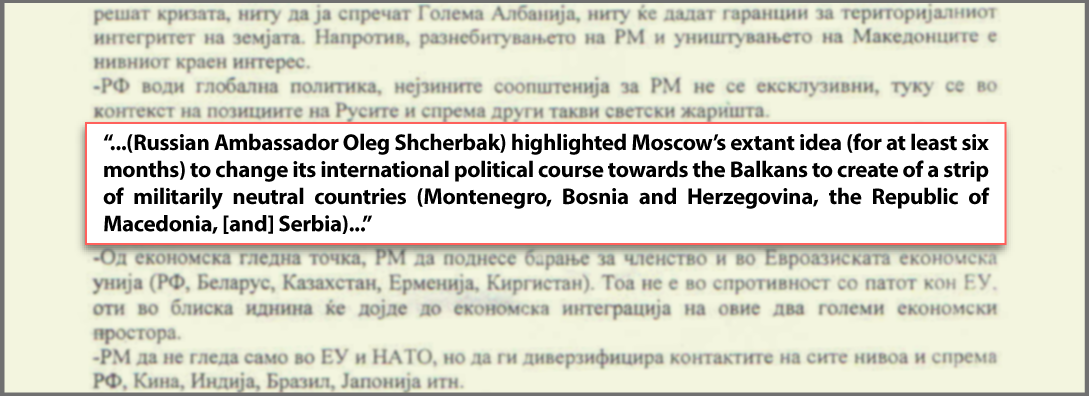
Shcherbak expressed frustration that Macedonian officials had not reciprocated Russia’s full-throated public backing in the face of “foreign interference,” and implied that the countries’ economic and diplomatic ties could be adversely affected if officials did not start supporting Kremlin policies, according to the document. Three Macedonian foreign ministry officials, who declined to be named because they were not authorized to speak to the media, separately confirmed the April 7 meeting took place, but did not confirm its content.

Russian foreign ministry officials did not respond to written questions.

Prime Minister Zaev declined to comment, but he referred OCCRP and partners to comments remarks he made in April warning of increased Russian influence in Macedonia.

“I believe that if no additional measures are undertaken, in regard to the low interest of the EU and the USA in this region, the Russian Federation will have more space to impose its own interests,” he said at the time.

A Nosy Neighbor

The allegations made in the tranche of intelligence documents are not limited to Russian influence. The collection also contains wiretaps and other surveillance showing an effort by Serbia’s Security Information Agency (BIA) to bolster nationalists in Macedonia. Serbia’s populist Prime Minister Aleksandar Vučić has avoided publicly taking sides in Macedonia’s crisis, but much of Serbia’s pro-government media have been strong backers of Gruevski and Russia. Serbia and Russia share deep cultural and religious ties and work together at times, although the government often plays the Americans and Russians off each other.

The documents show that Macedonian counterintelligence agents have been monitoring a BIA operative and embassy official in Skopje, Goran Živaljević, who, according to one assessment, has since 2015 worked to push back against the country’s integration with Europe.

The documents show Živaljević giving instructions to Ivan Stoilković, a pro-Russian Macedonian MP, who is the leader of a VMRO coalition partner, the Democratic Party of Serbs in Macedonia. Živaljević frequently met Stoilković “when making important decisions in the assembly or before meetings of the government,” according to one document.

Stoilković was observed to be in contact with Russian diplomats and TASS correspondents in Skopje, according to one document, which did not provide further details. He was among a number of Balkan politicians who traveled to Moscow last year to sign a declaration calling for the region to be “militarily neutral,” a position that would preclude an agreement with NATO.

Stoilković also met politicians and activists from nearby Montenegro who are opposed to that country joining NATO. They included Marko Milačić, an activist who Macedonian intelligence believes had previously met with a Russian diplomat working for military intelligence in Podgorica, the Montenegrin capital.

Milačić confirmed that he had met separately with Stoilković and Russian diplomats, but there was nothing untoward about the meetings.

“I’ve met Russian diplomats, but I’ve also met US diplomats,” he said.

“What the Macedonian secret service is doing is part of broader propaganda,” he said, referring to the documents obtained by OCCRP and partners. “It’s obviously purely politically motivated in order to consolidate political power in Macedonia.”

Zoran Zaev, then opposition leader, bloodied during violence in Macedonia’s parliament on April 27.Credit: Photo: Nake Batev / NOVA TV

Agents from Macedonia’s UBK tracked Živaljević around Skopje on April 27, including inside the parliament, as pro-VMRO demonstrators beat lawmakers. A photo obtained by UBK – and published by NOVA TV – shows Živaljević in the foreground as the melee unfolds behind him.

Last month, Macedonia summoned Serbia’s ambassador to explain the agent’s presence in parliament. Speaking to reporters the same day, Serbian Foreign Minister Ivica Dačić said Živaljević had not violated diplomatic protocol.

“Živaljević is the official representative of BIA in Macedonia, he is not there illegally,” Dačić said.

When contacted by phone, Živaljević declined to comment.

When questioned by a NOVA TV reporter, Stoilković, the Macedonian politician, refused to discuss his contacts with BIA.

“When you meet someone, do I ask you about that? Did I ever ask you about your communications and the people you communicate with? Shame on you,” he said. “You’re insulting me.”

According to the intelligence documents, both men were also caught on tape coordinating anti-Zaev propaganda in neighboring Serbia, where the media have carried a steady stream of stories warning that Western meddling and Albanian political claims could lead to war.

A series of wiretap transcripts starting on March 3 show Živaljević and Stoilković arranging a meeting between Gruevski and Miroslav Lazanski, a pro-Vučić lawmaker and one of Serbia’s most influential media commentators. The transcript also shows Stoilković telling Živaljević that he “briefed (Lazanski) on the column he needs to write.”

The resulting column by Lazanski in Serbian newspaper Politika on March 5 denounced Zaev and echoed VMRO’s calls for new elections. That evening, Živaljević and Stoilković spoke again to celebrate their success.

“I spoke to Lazanski earlier. He said the article reached record readership for Serbia,” Stoilković told the BIA agent.

“Excellent, excellent,” Živaljević replied.

For Macedonian intelligence, this was the tip of the iceberg. A separate document obtained by OCCRP and partners listed over 50 examples of commentary by Lazanski, including articles and appearances opposing Macedonian NATO membership, praising Russian military power, and blaming the West for fomenting unrest in Macedonia.

When asked about this, Lazanski denied he was working on behalf of intelligence services.

“I’m neither with the service nor a spokesman for the service,” Lazanski said. “I was not down there as a (parliamentary) deputy, but as a journalist.”

“My habit is that when I come to a foreign country, I call our embassy. Mr. Živaljević is a duly and legally accredited representative of our BIA in Skopje.”

Click here to view the documents.

Additional Reporting by Borjan Jovanovski, Maja Jovanovska, Aleksandra Denkovska and Vlatko Chalovski in Skopje, and Bojana Pavlović and Bojana Jovanović in Belgrade.

ARCHIVE

Sashka Cvetkovska

Sashka Cvetkovska

Еditor-in-chief

Sashka Cvetkovska is an internationally awarded investigative journalist and editor-in-chief of the Investigative Reporting Lab. Cvetkovska has worked on a number of national and cross-border investigations that have uncovered domestic and international crime, corruption, illicit arms trafficking and disinformation wars. The research she has worked on has been published in The Guardian, Buzzfeed, Süddeutsche Zeitung and others. Her current responsibilities are focused on increasing the impact of investigative reporting by creating new narratives of stories through film and campaigns. In that direction, she currently holds the position of producer of the Investigative documentary series Newsroom. For ten years, Cvetkovska has been part of the research team of the International Organized Crime and Corruption Reporting Project, an international media organization associated with IRL. She was a member of the Board of Directors of OCCRP and the Association of Journalists of Macedonia.

Elena Mitrevska Cuckovska

Elena Mitrevska Cuckovska

Editor for Development and Operations

Elena Mitrevska Cuckovska is the co-founder of IRL and together with the editor and his assistant, is responsible for monitoring and designing the implementation process of IRL activities. She is the project director of the documentary series Newsroom. She has been working with journalists for more than 10 years and has also worked on other technological solutions that allow more efficiency when searching public databases used by our reporters in order to make their work faster. She is a software engineer and graphic designer by profession and she is also the first technology expert who is trained and works in the field of media. She is part of the cross-border group of technological experts of OCCRP and contributes in collecting and analyzing information and as a researcher in IRL.

Bojan Stojanovski

Bojan Stojanovski

Editor and journalist

Bojan Stojanovski is a graduated journalist with over ten years of media experience. He worked in several national televisions – TV Alfa, TV 24 Vesti and TV Alsat. From first of November 2021, he is a part of the IRL team. Throughout his career, Stojanovski followed topics in the field of judiciary, crime, corruption. In 2013, he received “Nikola Mladenov” award for investigative journalism, on the topic “Employment in the public administration through the party list”.


Denica Chadikovska

Denica Chadikovska

Assistant managing editor for organization and communications

Denica Chadikovska is a graduated psychologist who started her journalistic career in 2017 as co-author and co-producer of the youth show Krik, funded by the UK Government. Chadikovska becomes part of the IRL team in 2018 as an investigative journalist – intern within the project for training future media leaders. In June 2020, she joins the position of communications officer in charge of implementing the IRL’s communications strategy as part of the communications and products team.

Maja Jovanovska

Maja Jovanovska

Researcher and journalist

Maja Jovanovska has a degree in journalism and follows topics in the field of corruption, crime and justice. In her long-term career, she worked in numerous media such as A1 television, Channel 5 television, Alsat and the NOVAtv portal before joining the founding board of IRL in 2018. She is the winner of domestic recognitions and awards and has participated in a number of trainings and conferences in the field of investigative journalism. She was a member of the management of the Independent Union of Journalists and Media Workers of Macedonia and the Council of Ethics in the Media in Macedonia, and is currently part of the management of ZNM.


Aleksandra Denkovska Gocevska

Aleksandra Denkovska Gocevska

Researcher and journalist

Aleksandra Denkovska Gocevska is a graduated journalist with ten years of experience. She worked in the daily newspaper Nova Makedonija, the Meta.mk news agency and the NOVATV portal. During her career, she worked on topics from the field of politics, urbanism, judiciary and corruption. She started working with investigative journalism in 2015 when she came to work as a reporter in the investigative newsroom of NOVATV. She is a participant in dozens of conferences and workshops on investigative journalism and is the author of the first undercover investigative story in Macedonia about the lives of the children from the May 25 home.

Aleksandar Janev

Aleksandar Janev

Researcher and journalist

Aleksandar Janev is a graduated economist who began his career as an economic journalist in 2008 at Alfa Television. He developed his professional reporting skills through training sessions with top economic journalists both domestically and abroad, including at Reuters in the United Kingdom. In 2010, he transitioned to the print media at Capital, where he worked until 2022. Concurrently, he contributed regularly to the Balkan Investigative Reporting Network (BIRN), and since 2018, he has been both an author and editor for the TV program “Agenda 35” broadcasted on Macedonian Radio Television. Since 2023, he has been a part of the IRL team focusing on corruption and economic crime.

Ivan Blazhevski

Ivan Blazhevski

Researcher and journalist

Ivan Blazhevski is a journalist specializing in international relations, crime, and corruption. He has been working as a journalist since 1998, and since 2001, he has been an editor and correspondent for the Spanish state news agency EFE covering Macedonia, Albania, and Kosovo. Throughout his extensive career, Blazhevski has contributed to numerous media outlets such as Makpress, Agence France-Presse (AFP), Vecer, Dnevnik, Vreme, and Radio Free Europe, serving as editor for news and documentary programs at TV ALSAT for 18 years. He joined the team at IRL in 2024. Blazhevski has been honored with an investigative journalism award from the Macedonian Institute for Media (MIM) and has produced television programs in multiple countries and regions, including Japan, Greenland, Bolivia, China, Nepal, Bangladesh, East Africa, Cuba, Peru, Denmark, Italy, Germany, among others.

Pelagija Mladenovska Stojančova

Pelagija Mladenovska Stojančova

Researcher and journalist

Pelagija Mladenovska Stojančova is a journalist with over 16 years of experience in the media industry. She began her career at the daily newspaper “Shpic” in 2008 and later worked at the weekly “Sega”. Since 2009, she has been part of the team at Radio Free Europe’s Macedonian language service, reporting on politics, crime, corruption, and economics across various media platforms. Since 2024, she has been employed at IRL as an investigative journalist. She holds a degree from the Faculty of Philosophy and continued her education at the School of Journalism at the Macedonian Institute for Media (MIM). Throughout her career, she has been involved in projects focused on educating and mentoring young journalists.

Luka Blazev

Luka Blazev

Graphic designer

Luka Blazev is a graphic designer at IRL who becomes part of the team in 2019. His career in the field of graphic design and art began in 2017 by working on several projects for various domestic and foreign companies. At IRL, Blazev is in charge of finding graphic solutions for the research and for the design of the promotional content resulting from the research, which follows the communication strategy of IRL.

Trifun Sitnikovski

Trifun Sitnikovski

Director of "Newsroom"

Trifun Sitnikovski has been working in the film industry for more than a decade. He has shot more than a dozen short action films, short documentaries and three TV series on which he worked as screenwriter, director and executive producer. In addition to directing films, he has also worked on numerous projects as a producer, editor, cinematographer, assistant director and script supervisor for short films, TV shows, documentaries, commercials and music videos. His latest project as a director and screenwriter is the documentary series “Newsroom”.

Trajce Antonovski

Trajce Antonovski

Cinematographer

Trajce Antonovski is a cameraman and part of the cinematographers of the documentary series Newsroom. Antonovski has been working for more than 10 years on the visual realization of sports competitions under the auspices of UEFA and EHF. He worked in the newsroom of A1 and the NOVATV portal, and was part of the team for the realization of the political shows “Eurozum”, “Provereno”, as well as numerous entertainment projects such as the popular quiz “Who wants to be a millionaire”, “50-50 ” and other projects. In IRL Macedonia, he is part of the team in charge of filming the stories.

Gorjan Atanasov

Gorjan Atanasov

Video editor and producer

Gorjan Atanasov is a film and TV video editor with more than 8 years of experience in the film and television industry. Atanasov has worked on several features and documentary projects. As an editor, he has signed 6 short feature films, 2 feature-length documentaries, and currently he works in IRL as a video editor for the documentary series “Newsroom” and short video stories and multimedia projects of the organization.

The “Postal Bank” case dates back more than two decades. For just as long, investigators have examined the privatization of the country’s first state bank. The case was reopened in 2018 by the then Special Public Prosecutor’s Office (SPO). After the dissolution of the SPO, however, the case was transferred to the Prosecutor’s Office for the Prosecution of Organized Crime and Corruption.

On June 13, 2024, the Criminal Court in Skopje halted the proceedings, citing the controversial amendments to the Criminal Code adopted by the government of SDSM and DUI. The case had been conducted against businessman Tome Glavchev, current president of the Basketball Federation of Macedonia; Ratko Dimitrovski, former mayor of Kochani from VMRO-DPMNE; and the lawyer Zoran Shuklev.

They were prosecuted on charges of abuse of official position and money laundering. The oversight established that the Criminal Court’s decision did not specify under which article of the Criminal Procedure Code the proceedings had been terminated.

The Prosecutor’s Office for the Prosecution of Organized Crime and Corruption, dissatisfied with the ruling, filed an appeal, arguing that Glavchev, Dimitrovski, and Shuklev should at minimum face accountability for the offense of money laundering.

However, High Public Prosecutor Jovan Cvetanovski waived the right to pursue the appeal before the Court of Appeal. He justified this decision through an official note, yet the oversight concluded that the reasons given for withdrawing the appeal were contradictory and unclear.

“Public Prosecutors Lile Stefanova and Elvin Veli believe that by withdrawing the appeal of the Basic Public Prosecutor’s Office for the Prosecution of Organized Crime and Corruption, the public prosecutor from the Higher Public Prosecutor’s Office Skopje did not act professionally, expertly and legally,” the report states.

Prosecutor Dzelal Bajrami, however, assessed that Cvetanovski had acted within his competencies. With the appeal withdrawn, the Court of Appeal no longer had the opportunity to consider the case. The proceedings were effectively closed.

The second case concerns illegal construction in the village of Zelenikovo involving Dragan Pavlovik-Latas and his two brothers, Zvezdan and Srdzan Pavlovik. On July 4, 2019, the Criminal Court acquitted them of all charges. The same verdict was reached again during the retrial on July 18, 2022.

The Public Prosecutor’s Office in Skopje filed an appeal. On October 10, 2023, the appeal was accepted and a hearing was scheduled before the Skopje Court of Appeal. On November 6, 2023, the case was formally presented at the Public Prosecutor’s Office. Present at the session were the then State Public Prosecutor Ljubomir Joveski, public prosecutors Ferat Elezi and Sonja Simovska, and high public prosecutors Mustafa Hajrullahi and Jovan Cvetanovski.

“The conclusion from the presentation was that the public prosecutor representing the case at the Court of Appeal should propose commissioning an expert examination to determine whether the actions taken in the construction works constituted preparatory acts and to establish the date when construction began. An expert witness should be summoned to the main hearing to clarify the open questions,” the oversight report from the Skopje Higher Public Prosecutor’s Office states.

The very next day, the defense for the Pavlovik brothers submitted a new piece of evidence to the Court of Appeal — an expert report and opinion prepared by a defense-appointed expert witness. Cvetanovski requested that the hearing be postponed so he could cross-examine the expert. However, according to the oversight findings, what followed raised serious concerns.

“The public prosecutor at the hearing did not ask the questions he had previously announced in the record from November 7, 2024, and the questions that were posed did not elicit answers from the expert on the disputed issues raised during the presentation before the Public Prosecutor’s Office of the Republic of North Macedonia,” the report states.

Cvetanovski also failed to follow the instructions issued during the internal prosecutorial meeting at the prosecution office to commission an independent expert examination. Instead, he accepted the expert report submitted by the defense.

“The public prosecutor acted contrary to Article 37 of the Rulebook on Internal Operations of Public Prosecutor’s Offices, according to which the position and opinion adopted after the presentation are binding for the lower public prosecutor’s office,” prosecutors Lile Stefanova and Elvin Veli wrote in the oversight report.

However, the third member of the supervisory commission, Dzelal Bajrami, disagreed. He concluded that Cvetanovski had acted in accordance with the conclusions adopted during the presentation at the internal prosecutorial meeting.

The third case examined during the oversight concerns the “Serta” case, involving public tenders for cleaning government institutions. The case reached the Higher Public Prosecutor’s Office after the Basic Public Prosecutor’s Office filed an appeal against a decision of the Criminal Court.

When reviewing the indictment, the Criminal Court accepted the objections raised by the accused Spaso Gjorgiev and the company “Serta,” who were prosecuted for abuse of procedures in a public procurement call. On January 29, 2024, the Basic Public Prosecutor’s Office appealed that decision.

It was in connection with this case that a report emerged of pressure being exerted on an official at the Skopje Higher Public Prosecutor’s Office responsible for registration and allocation of cases. According to her testimony, she received instructions from the then head of the Higher Prosecutor’s Office, Mustafa Hajrullahi, indicating which prosecutor should be assigned to the case.

“For the ‘Serta’ case, I was told to register it and assign it to public prosecutor Jovan Cvetanovski,” said Daniella Lape, an employee in the Skopje Higher Public Prosecutor’s Office. Her testimony is included in the oversight report.

At the Court of Appeal hearing on April 9, 2024, high prosecutor Cvetanovski withdrew the appeal.

“An inspection of the official note dated April 9, 2024 shows that the public prosecutor analyzed the evidence attached to the indictment, which is contrary to the provisions of the Criminal Procedure Code, Articles 336 and 337, given the stage of the proceedings in which the case was at the time,” the oversight report states.

This interpretation is consistent with the Supreme Court's legal opinion issued on December 7, 2021, which states that the Council responsible for reviewing an indictment does not analyze the evidence or assess its quality. Its role is limited to determining whether evidence has been obtained unlawfully — an issue that should have been the focus of Cvetanovski’s argument.

“A judgment of the Supreme Court of the Republic of North Macedonia was issued in this case on September 11, 2024. In that ruling, the court established a violation of the law in favor of the defendants. The judgment further states that the violation committed by the Council reviewing the indictment could have been remedied if the high public prosecutor had not withdrawn the appeal,” the oversight document notes.

In their conclusions regarding this case, the public prosecutors Lile Stefanova and Elvin Veli wrote that by withdrawing the appeal, prosecutor Cvetanovski did not act professionally, competently, or in accordance with the law. They further stated that he engaged in an analysis of evidence and the existence of intent to commit a criminal offense — matters that fall within the exclusive authority of the court. Nevertheless, the public prosecutor Dzelal Bajrami again took the position that Jovan Cvetanovski had acted within the scope of his authority.

The fourth case selected for additional scrutiny also involved the prosecutor assigned Roman numeral II — Jovan Cvetanovski. At first glance, it appeared routine: a case concerning the illegal serving of alcoholic beverages to a minor.

The court in Negotino found Gjorgji Lazov, Ilija Vangelov, and the company DPTU “S.O.S. Obezbeduvanje (Security)” DOO Negotino guilty. The defendants challenged the verdict, filing an appeal that moved the case to the Higher Public Prosecutor’s Office in Skopje.

On February 3, 2023, the Skopje Court of Appeal overturned the ruling and returned the case for retrial. Prosecutor Jovan Cvetanovski did not attend the public hearing at the appellate court, despite the fact that the Higher Prosecutor’s Office in Skopje had previously concluded that the defendants’ appeals were unfounded.

On May 8, 2023, the court in Negotino issued a new verdict, again finding the defendants guilty. The defendants once more appealed the decision.

“On August 23, 2023, the public prosecutor at the Higher Public Prosecutor’s Office in Skopje, Jovan Cvetanovski, submitted a written proposal KOŽ.no. 1187/23 to the Skopje Court of Appeal, proposing that the defendants’ appeals be rejected as unfounded,” the oversight report states.

In that submission, Cvetanovski argued that the retrial had been conducted in accordance with the appellate court’s instructions and that the deficiencies identified in the initial proceedings had been fully addressed.

Yet only months later, his position shifted.

“At the hearing on 26 December 2023, the public prosecutor withdrew the indictment. From the review of the Skopje Court of Appeal’s judgment, it is evident that no new evidence was presented during the hearing and nothing altered the factual situation compared to the moment when the written proposal had been submitted,” the oversight report notes.

On the same day — December 26, 2023 — Cvetanovski drafted an official note stating that he had withdrawn the indictment because there was insufficient evidence to support the criminal offense.

The three prosecutors who conducted the oversight — Lile Stefanova, Elvin Veli, and Dzhelal Bajrami — reached a rare point of consensus regarding this decision. In earlier cases examined during the oversight, Bajrami had taken the view that Cvetanovski’s actions fell within his legal authority. In this instance, however, he concluded otherwise.

“Public prosecutors Lile Stefanova, Elvin Veli and Dzhelal Bajrami believe that, taking into account the written proposals in both proceedings and the positions expressed in them, and in a situation where no new evidence was presented at the main hearing, by dropping the indictment the public prosecutor did not act professionally, expertly and legally,” the oversight report states.

Despite this joint assessment, the 20-page oversight report ultimately carried only two signatures — those of Lile Stefanova and Elvin Veli.Dzhelal Bajrami did not sign the document, which was later submitted to then–State Public Prosecutor Ljupco Kocevski.

Attached to the report were Bajrami’s own official note, as well as a separate report from five employees describing how Mustafa Hajrullahi, while serving as head of the office, allegedly pressured them over the registration and allocation of cases within the Higher Public Prosecutor’s Office in Skopje.